
After a hammer raid in Lyon, how laser-inscribed report numbers help trace stolen diamonds
Burglars smashed the front of a jewellery shop in central Lyon before dawn on 23 September and fled with pieces from its displays, most or all of them replicas according to the brand and the local press. The raid is a reminder of what identifies a real diamond once it has left the shop: the report number laser-inscribed on its girdle, and the limits of that mark.
What happened
At about 3:30 a.m. on Wednesday 23 September, hooded people broke the shop front of the Edenly jewellery shop, at the corner of rue des Archers and place des Célestins in Lyon’s 2nd arrondissement, with hammers, took pieces from the displays as the alarm rang and fled in a white Renault Clio, according to Le Progrès, BFM Lyon and Lyon Capitale. Most reports mention three people; BFM Lyon and TF1 counted four, including a driver. The car had been reported stolen, TF1 said.
The Lyon prosecutor’s office opened an investigation, led by the Rhône territorial crime division, and TF1 reported on 24 September that it concerns organised theft and criminal conspiracy. No arrest had been reported at the time of writing.
A loot of replicas
On 25 September Le Progrès reported that all the pieces taken were display replicas, as a notice in the window stated. Speaking to TF1, the brand’s founder described about 300 pieces, “a large majority” of them demonstration replicas, and a loss of several thousand euros rather than the hundreds of thousands real pieces would have represented. A saleswoman told France 2 that real gold and diamond jewellery is made to order only. The shop, opened this summer, was due to reopen on 25 September (Lyon Mag).
According to TF1, it was the second jewellery shop burgled in Lyon in two weeks. The judicial police told the channel that thefts in the precious metals and watch sector are rising notably, partly because of a very high gold price, mainly on the outer fringes of the Lyon and Besançon areas (our translation). On 16 September, Le Progrès reported an armed robbery at a Vieux-Lyon shop that buys and resells antique jewellery, with a loot estimated at €138,000. Gold “can very easily be melted”, Thibaut Fontaine, head of France’s central office against organised crime, told franceinfo in November 2025, which makes it hard to trace (our translation).
The number on the girdle
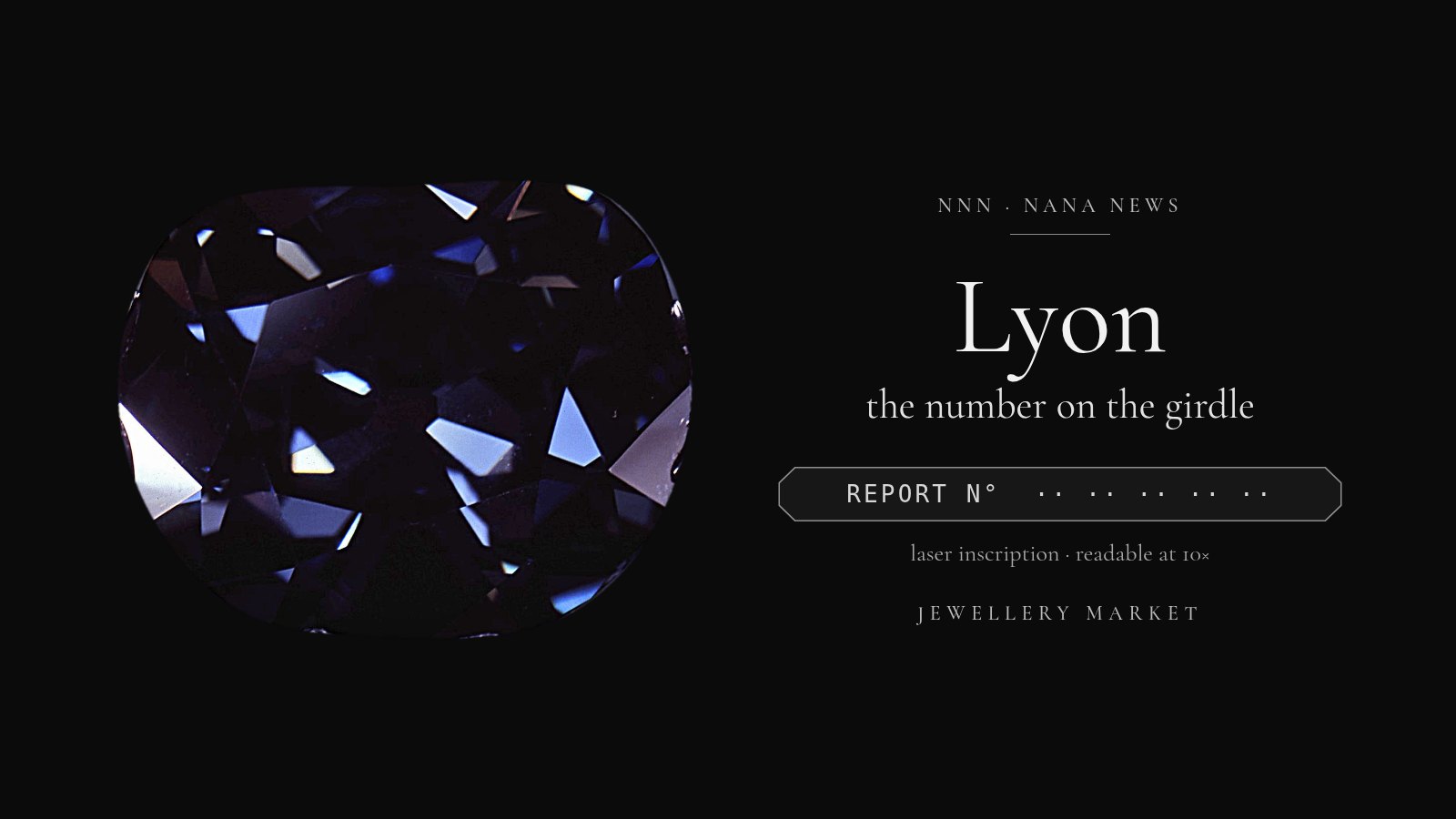
A diamond can carry an identity that gold cannot. GIA laser-inscribes a diamond’s report number on its girdle, the narrow edge around the widest part of the gem; the inscription is invisible to the naked eye but can be read under 10× magnification. IGI and HRD Antwerp offer the same service, which IGI says allows fast identification and verification. The technique goes back to a patent filed in 1980 by Lazare Kaplan & Sons, granted in 1983, which already cited identifying a diamond “if stolen or lost”.
The number is the key to the laboratory’s database. Entered on GIA Report Check, IGI’s report verification or HRD’s online portal, it returns the details of the original report. It can also help after a theft. In 2024 GIA said it had helped recover two diamonds of more than four carats stolen from a home in Colorado: when an uninvolved dealer sent them for grading, GIA identified them as matching those reported stolen. “GIA often receives requests from law enforcement to help them recover GIA-graded diamonds that are reported lost or stolen,” said Christina Yates, GIA associate general counsel. Gemprint also accepts reports of stolen diamonds registered with it. We found no public registry of stolen diamonds searchable by report number.
The limits of the mark
A girdle inscription sits on the surface. Researchers at the Swiss laboratory SSEF wrote in 2019 that such marks can be lost when a gem is recut, and may be completely erased by slight polishing. A number can also be forged: in a 2025 Lab Note, GIA described four diamonds submitted in Dubai with counterfeit GIA report numbers, and warned that a fraudulent inscription could be overlooked by simple visual examination.
An inscription exists only if someone ordered it, so a diamond cut before the technique existed, or never sent to a laboratory, carries none. Coloured gems can be inscribed too, as SSEF has shown on a ruby, though its researchers noted that sub-surface marking was not yet a standard service for them. Without an inscription, a gem can only be matched to its report by its description, weight, measurements and photographs.
Our view
In our view, the lesson lies in the difference between metal and gems. Melted gold leaves no trail. A graded diamond does, but only if its owner kept the number, the mark survives and someone checks it when the gem resurfaces. We advise every owner of a graded diamond to keep the report number and a photograph of the inscription away from the jewellery box and, for a coloured gem, a detailed report with photographs and measurements.
David Nataf is a GIA Graduate Gemologist (GG) and gem dealer.
- Le Progrès, “Lyon. « J’ai rigolé sur le coup » : en pleine nuit, trois cambrioleurs ciblent maladroitement une bijouterie” (in French). www.leprogres.fr, 23 September 2026.
- BFM Lyon, “Une bijouterie cambriolée en pleine nuit à Lyon, les auteurs du vol en fuite” (in French). www.bfmtv.com, 23 September 2026.
- TF1 Info, “Attaque d’une bijouterie à coups de marteau à Lyon : les images impressionnantes des braqueurs avant leur fuite” (in French). www.tf1info.fr, 23 September 2026.
- franceinfo / France 2, “« Il n’y a pas de vrais bijoux » : des voleurs ont braqué une bijouterie au marteau avant de découvrir qu’ils étaient factices” (in French). www.franceinfo.fr, 23 September 2026.
- TF1 Info, “Bijouterie cambriolée à Lyon : les malfaiteurs ne savaient pas qu’ils étaient filmés… et qu’une autre surprise les attendait” (in French). www.tf1info.fr, 24 September 2026.
- Laurence Loison, Le Progrès, “Lyon. Ils cambriolent une bijouterie à coups de marteau : tous les bijoux dérobés sont factices” (in French). www.leprogres.fr, 25 September 2026.
- Vincent Guiraud, Lyon Capitale, “Braquage d’une bijouterie à Lyon : les bijoux dérobés étaient factices” (in French). www.lyoncapitale.fr, 25 September 2026.
- Lyon Mag, “Cambriolage d’une bijouterie à Lyon : les bijoux dérobés étaient factices, l’enseigne rouvre ses portes” (in French). www.lyonmag.com, 25 September 2026.
- Laurence Loison, Le Progrès, “Métropole de Lyon. « Je ne vous veux pas de mal, j’ai des dettes » : il séquestre deux salariés et braque une bijouterie du Vieux-Lyon” (in French). www.leprogres.fr, 16 September 2026.
- Yannick Falt, franceinfo, “« Le cours de l’or aiguise l’appétit des malfaiteurs », affirme le chef de l’Office central de lutte contre le crime organisé” (in French). www.franceinfo.fr, 6 November 2025.
- GIA, “What is a laser inscription and is it important?” www.gia.edu, accessed 26 September 2026.
- GIA, Report Check. www.gia.edu, accessed 26 September 2026.
- IGI, “IGI Laserscribe”. www.igi.org, accessed 26 September 2026.
- IGI, “Verify Your Report”. lookup.igi.org, accessed 26 September 2026.
- HRD Antwerp, FAQ. hrdantwerp.com, page dated 4 September 2026.
- US Patent 4,392,476, Lazare Kaplan & Sons, “Method and apparatus for placing identifying indicia on the surface of precious stones including diamonds”. www.freepatentsonline.com, filed 23 December 1980, published 12 July 1983.
- GIA, “GIA Helps Recover Diamonds in Colorado”, press release. www.gia.edu, 5 February 2024.
- Gemprint, “Report Lost / Stolen Diamond”. www.gemprint.com, accessed 26 September 2026.
- N. Chan, S. Pradhan, “HPHT-Processed Natural and Laboratory-Grown Diamonds with Counterfeit Inscriptions”, Gems & Gemology Lab Notes. www.gia.edu, Summer 2025.
- L.E. Cartier et al. (SSEF), “Laser Inscription and Marking of Gemstones”, InColor, issue 43 (PDF). www.ssef.ch, Summer 2019.
Spotted an error? Corrections policy · Editorial policy