
Interview: Israel Diamond Exchange president Nissim Zuaretz calls for a diamond free-trade zone
Israel’s diamond bourse will keep its biggest traders only if the state creates a diamond free-trade zone, its president Nissim Zuaretz told us in Ramat Gan on 11 February 2026. He also called laboratory-grown diamonds “not diamond” and said Israeli traders follow US sanctions on Russian goods. In July he resigned before the end of his term; he stays in office until elections expected in November or December.
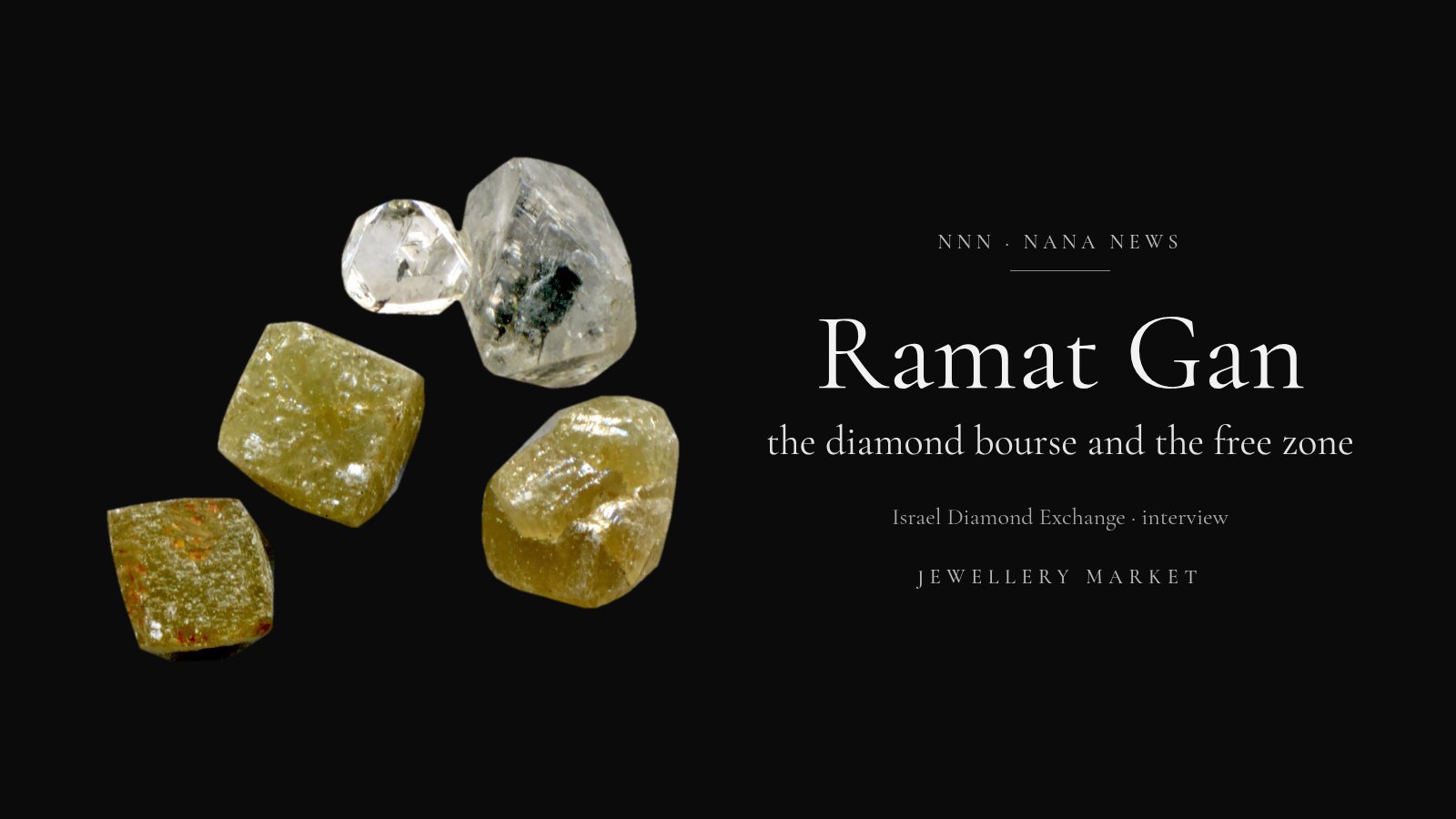
Twenty years later, in Ramat Gan
We met Nissim Zuaretz at the Israel Diamond Exchange (IDE) in Ramat Gan on 11 February 2026. I had first walked its trading floors twenty years earlier. Zuaretz was elected unopposed in May 2024 for a three-year term, becoming the exchange’s 11th president (Rapaport). In 2007 he co-founded DN Diamonds, a large-diamond specialist headquartered at the bourse, with offices in Dubai, New York and Hong Kong; the company has won Israel’s Outstanding Exporter award three times (IDE, Globes).
From Achuzat Bayit Street to Ramat Gan
The Israeli trade started in Tel Aviv. According to the exchange’s own chronology, the Israel Diamond Club was founded there on 8 October 1937 and moved in December 1947 to 3 Achuzat Bayit Street. The story told in the trade is that Moshe Schnitzer, who played an active part in unifying the trade’s organisations in 1947 and presided over the exchange from 1967 to 1993, first asked Tel Aviv’s mayor for room to grow, and that the mayor turned him down because the country had no diamond deposits. What is documented is that, after difficulties with the Tel Aviv municipality, Ramat Gan’s mayor Abraham Krinitzi offered his city, then largely undeveloped; the land contract was signed on 14 November 1961 (Wikipedia). The first tower, Shimshon, opened on 24 October 1968, the Diamond Tower in 1993 and a rough-trading hall in 1998.
The industry was built by Holocaust survivors and Jewish immigrants from Belgium and the Netherlands, who brought their cutting and polishing skills. For decades diamonds were the only export in which Israel was more than a marginal supplier: in 1986 they earned nearly US$1.7 billion, about 24% of the country’s exports, according to the US Library of Congress country study. In 2024 they still accounted for about 8% (Rapaport).
Then the model changed. The polishing of smaller diamonds moved to lower-cost centres, above all India, where production is cheaper, as Zuaretz told Globes in 2025. In December 2016 the industry signed a new agreement with the Tax Authority: diamantaires, who had paid tax on turnover even in loss-making years, would from then on be taxed on profits (Gems2Jewellery). And Dubai became the leading hub: the DMCC reports record diamond trade of US$41.7 billion through the emirate in 2025. Zuaretz sees where Ramat Gan still has the edge: “We are the specialists of big stones. For expensive ones you need a professional cutter, and the salary for that lifetime experience will never be replaced.”
Lab-grown: “it is not diamond”
On laboratory-grown diamonds, Zuaretz does not mince his words. “It is not coming from diamond, it is not diamond, it is nothing. Real diamond comes from the earth where it stays millions of years,” he told us. “This horrible CVD lab-grown thing is sold for 70 dollars per carat.” He compares them with Swarovski crystal: attractive, but without geological rarity or emotional weight. He cites offers in which a restaurant bill costs more than a lab-grown engagement ring, or in which the gold of the mounting is worth more than the gem. These are his opinions and figures; we have not verified the price he quotes.
Regulation is moving towards a clearer distinction. India’s standard IS 19469:2025 states that the word “diamond”, used without qualification, may refer only to a natural diamond, and bans terms such as “lab diamond” (Bureau of Indian Standards). In Antwerp, the HRD laboratory stopped grading loose laboratory-grown diamonds on 1 January 2026, while still issuing reports for jewellery set with them (AWDC, JCK). Zuaretz expects the rest of the market to follow: “Soon everywhere, the market will not call lab-grown ‘diamond’ anymore. It is like Swarovski.”
Sanctions, Africa and 25 centuries of trade
Sanctions on Russia have redrawn supply routes. The European Union, acting with its G7 partners, has banned imports of Russian diamonds since 1 January 2024, then Russian diamonds processed in third countries: from 1 March 2024 for diamonds of one carat and above, and from 1 September 2024 from 0.5 carat (European Commission).
Zuaretz says Israeli traders stick to the American line. “America says we can’t deal with Russia, the banks will not send the money. We respect exactly the words and laws of America,” he said. “It’s a pity but we don’t deal with Russian goods until something changes.” For him, the future lies further south: “Africa is the future, controlling the market because Russia is out… No sanctions for Africa as long as Kimberley Process.”
The bourse has also lived through the war. On 19 June 2025 an Iranian missile struck the vicinity of the Diamond Tower complex in Ramat Gan, shattering windows in several buildings and starting fires, The Media Line reported. “Iranian missiles hit close to the Borsa but not the Borsa,” Zuaretz said. He sees the trade as older than today’s conflicts, recalling that Iranians call the diamond almas and that the Hebrew word yahalom appears in the Book of Ezekiel. “We diamantaires know each other and trade together since more than 25 centuries: Persians, Jews, Arabs, Azerbaijan, Bukhari.”
Machines and the diamantaire’s eye
“Every machine is coming from Israel and then they copy us,” Zuaretz says of the trade’s equipment, a claim we could not measure. He cites the colorimeters made by Zvi Yehuda, which he says assess colour in seconds; DiamondWorld describes one model that predicts the colour of rough diamonds from D to K. In our experience as GIA-trained gemologists, even GIA combines instruments with the judgement of its graders.
Artificial intelligence, he says, can grade a polished diamond but cannot predict what a rough crystal will yield, for instance whether it will end up VS1 or SI2 in clarity. “No two stones the same… This takes a lifetime of a diamantaire.” Recalling how the invention of the French engineer Roland Moreno’s chip came to be forgotten, he warns that know-how can be lost, and draws one conclusion: “The only way is a free zone.” Zuaretz also told us that he invests in Kimby.io, a platform offering accredited investors fractional ownership of high-value natural diamonds. We mention it for transparency about his interests; it is not an investment recommendation.
The free-zone demand
This is the heart of his message. “The government needs to help us with the free zone. Every government helps their diamond exchange: India with banking, Dubai with free tax. Israel has zero help,” Zuaretz said. “If no help, the 10 biggest traders will leave.”
The demand is not new. In May 2025 he told Globes that a free-trade zone was “a matter of life and death for the industry”. In September 2025, during a visit to the bourse, Finance Minister Bezalel Smotrich said he would include in the 2026 budget a proposal to make Israel a free-trade zone for diamonds, a project spearheaded by Zuaretz (Rapaport). The model is Dubai: exemption from import and export duties and currency restrictions, and from personal and corporate taxes. At the time of writing, we have found no public confirmation that the zone has been adopted.
Since our interview, the situation has moved on. On 26 July 2026 Rapaport reported that Zuaretz had resigned before the end of his term; he remains in office until the election of a successor, scheduled for November or December. According to the Ministry of Economy and Industry, quoted in the same article, Israel’s polished diamond exports fell 22% year on year to US$625.7 million in the first half of 2026. The IDE has also rejoined the World Federation of Diamond Bourses after a year’s absence.
Our view
In our view, Ramat Gan still holds what is hardest to relocate: the eye and experience needed to buy a large rough diamond and cut it well, and a trade that says it applies sanctions to the letter. But these strengths now depend on decisions taken outside the bourse. Whether the free zone materialises, and who leads the exchange after the elections, will largely decide whether the biggest traders stay. We will follow both questions.
David Nataf is a GIA Graduate Gemologist (GG) and gem dealer. The interview took place at the Israel Diamond Exchange in Ramat Gan on 11 February 2026.
- Rapaport, “Israel Diamond Exchange Names Nissim Zuaretz as President”. rapaport.com, 21 May 2024.
- Israel Diamond Exchange, “Nissim Zuaretz”, management page. en.isde.co.il, accessed 26 September 2026.
- Dean Shmuel Elmas, Globes, “Restoring the luster to Israel’s diamond industry”. en.globes.co.il, 22 May 2025.
- Israel Diamond Exchange, “Important Dates”. en.isde.co.il, accessed 26 September 2026.
- Israel Diamond Exchange, “Moshe Schnitzer”. en.isde.co.il, accessed 26 September 2026.
- Wikipedia, “Diamond Exchange District”. en.wikipedia.org, accessed 26 September 2026.
- Library of Congress, Israel: A Country Study, “Diamonds”. countrystudies.us, 1988.
- Gems2Jewellery, “IDE Reaches New Agreement with Tax Authority”. gems2jewellery.com, 20 December 2016.
- DMCC, “DMCC Announces Record USD 41.7 billion in Diamond Trade Through Dubai in 2025”, press release. dmcc.ae, 13 July 2026.
- Bureau of Indian Standards, Standard of the Week: IS 19469:2025 (PDF). www.bis.gov.in, February 2026.
- AWDC, “World First: Antwerp Diamond Lab HRD Becomes First in the World to End Quality Certification for Loose Synthetic Diamonds”. www.awdc.be, accessed 26 September 2026.
- JCK, “HRD Antwerp to Stop Grading Lab-Grown Diamonds”. www.jckonline.com, 23 June 2025.
- European Commission, “Restrictions on diamonds: frequently asked questions” (PDF). finance.ec.europa.eu, as of 17 December 2025.
- Steven Ganot, The Media Line, “Iran Strikes Israel’s Soroka Hospital, Diamond Exchange; Netanyahu Vows Revenge”. themedialine.org, 19 June 2025.
- DiamondWorld, “OGI and Zvi Yehuda launch Colorimeter model-F”. www.diamondworld.net, accessed 26 September 2026.
- Leah Meirovich, Rapaport, “Israel Finance Minister Wants Country to Be Free-Trade Zone for Diamonds”. rapaport.com, 25 September 2025.
- Joshua Freedman, Rapaport, “Israel Diamond Exchange President Resigns”. rapaport.com, 26 July 2026.
Spotted an error? Corrections policy · Editorial policy